



















You’ve put a lot of effort into building your online store. From great products to detailed product descriptions, every element matters. But there’s one little feature which—if it’s not been properly executed—could be undermining your efforts: The functionality of your website’s search bar.
Most e-commerce platforms—such as Shopify, Magento, and WordPress—come with a basic search function. This would suffice if customers invariably typed in the exact words used in your product names and descriptions. But what happens when they don’t?
The Limitations of Pure Keyword-Matching Search
Consider a shopper on a fashion site searching for a “light cotton dress.” Say the company has numerous products whose titles include the phrase “summer dress,” with the word “cotton” in the product description. The search might show nothing if none of those products have the word “light” in the product title or description.
In fact, on the shopping site of a major Indian fashion brand, the first result for “light cotton dress” is a certain “midi dress light beige”—which comes up because the search function matched the words “dress” and “light,” and didn’t realise that “light beige” refers to a colour rather than lightness in terms of weight.
On a similar site with even more limited search functionality, the really simple search phrase “cotton dress” brings up just four results. The site apparently tries to find products whose descriptions include all the words in a search query. You can imagine what shoppers on such sites would see if they typed in “long, flowing blue dress for a beach vacation”: Nothing.
And that is the problem with traditional e-commerce search: Users need to adapt their language to the language of the company’s catalogue.
(Slightly) Smarter: Beyond Exact Keyword Matching
Next up are examples of search that goes beyond exact keyword matches—but still falls short of understanding user queries. Amazon’s search functionality, surprisingly, falls in this category. Considering only non-sponsored results, an Amazon search for “sundress” would ideally show all casual dresses for women made from lightweight fabric and designed for warm weather—which is what a sundress is. The actual results, however, heavily prioritise products whose names contain the word “sundress.”
Next, you’d imagine that the search phrase “cheese that melts easily” is easy enough to understand, but Amazon.in doesn’t. Sponsored results apart, you’ll see just three results—and only the third is relevant. Amazon.com is worse: It only brings up cookware such as cheese melt pans—and, interestingly, a stress-relieving toy shaped like a cheese wedge.
A good step ahead is Bigbasket.com, an Indian online grocery store, which is able to work with the phrase “cheese that melts easily.” The product names of the first four results contain either “Melto,” “melt,” or “meltable” (and not “melts”). This is an example of search functionality going beyond mere keyword matching—but only just!

Enter Natural Language Search
Now, imagine a search bar that understands what your customers mean, not just the words they type. This is the essence of natural language search (NLS), made possible by search tools like Typesense paired with Large Language Models (LLMs). This approach—AI-powered search that uses natural language processing techniques—feels far more “human” and intuitive.
Typesense is an efficient, open-source search engine with superfast indexing and retrieval capabilities. Its open source nature means flexibility without the complexities of proprietary systems. Importantly, it can work hand-in-hand with advanced AI—in the form of LLMs, which we’ll discuss later—to power sophisticated natural language search.
NLS enables customers to use plain language to ask for what they want because the underlying AI comprehends the intent behind their queries. They can find what they’re looking for even if they don’t know your exact product titles. Phrases like “show me a durable laptop for students” or “do you have men’s waterproof hiking boots, size 9” work exactly as the user would want them to.
All this means less frustration, fewer dead ends, and a smoother shopping experience. It’s like having a smart assistant built right into your website.
Typesense + AI = Superfast Natural Language Search
Typesense in conjunction with an LLM takes product search to a new level by:
Bridging the brand vs user-language gap: Brands use specific terminology for their products, which may differ from how users describe them. The LLM maps the user’s everyday queries to brands’ product schema so Typesense can deliver meaningful search results. For example:
- A search for a “budget-friendly laptop” would be mapped to products categorised as “affordable,” “economy,” or “value for money.”
- When a user looks for “eco-conscious cleaning products,” it is understood as a search for “sustainable,” “recycled materials,” or “organic” products.
- A query for a “hard-wearing rucksack for hiking” will correctly identify products marked as “durable” or “heavy-duty.”
- “Quick-cook meal options” will be understood as “convenience food,” “instant,” or “pre-prepared” items.
Inferring meaning using natural language processing algorithms: Typesense working with an LLM understands natural language searches, inferring meaning even when users don’t employ keywords or precise language. For users, this means the freedom to “say what they mean” rather than formulating and re-formulating search queries.
Furthermore, the use of natural language processing models in product search offers:
- Contextual understanding and ambiguity resolution: Differentiating between multiple meanings of a word based on context (“apple” as a fruit vs “apple” in technology)
- Attribute and intent extraction: Precisely extracting product attributes (colour, size, material) and user intent (“show me,” “filter by”) from natural language searches
- Handling of complex queries: Making sense of lengthy, descriptive phrases that would confuse keyword-matching systems
- Personalisation: Enhancing personalised search (when integrated with user data) by understanding user preferences from queries over time
Yes, You Do Need NLS!
If you’re wondering whether all this is something your store really needs, the answer is Yes. NLS is easy to add and works with most popular platforms.
Prominent retailers including Sephora and home24 have incorporated natural language search into their platform to enhance product discovery. Zalando, Europe’s leading online platform for fashion and lifestyle, recently began streamlining product search using ChatGPT’s natural language processing techniques. Walmart acquired an NLP startup in 2019 to boost their e-commerce capabilities.
Remember our example searches—“cotton sundress” and “light cotton dress,” which posed difficulties for sites with basic keyword search—and the phrase “long, flowing blue dress for a beach vacation,” which most fashion sites apparently can’t understand? Zalando’s AI-powered search does understand the phrase:
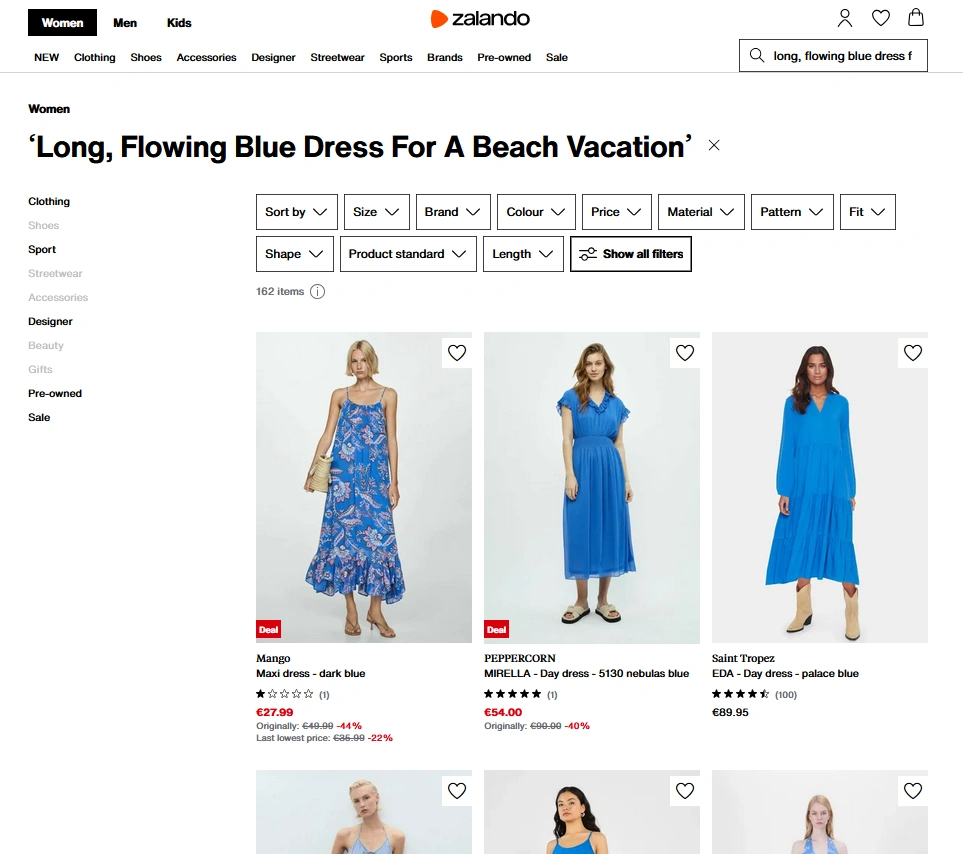
This is a good example of intent-based search: The site interpreted a natural-language query, including the phrase “for a beach vacation,” to get at the user’s intent. Compare this search experience with one where the site struggles with the phrase “light cotton dress”!
The AI Magic Under the Hood: LLMs and Intent Translation
LLMs excel at comprehending context, intent, and nuances in human language, which is crucial for effective search. Here’s how the process typically unfolds:
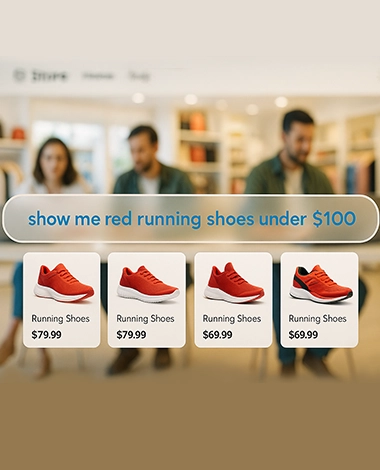
User Types Natural Language Query: A shopper types a phrase like “red running shoes under $100” into the search bar.
LLM Processes Query: The LLM analyses this query and identifies key entities such as the product type (“shoes”), colour (“red”), and price range (“under $100”), alongside the user’s intent (to search, filter, and possibly sort for running-specific shoes).
In the case of the much more complex “long, flowing blue dress for a beach vacation,” the “beach vacation” phrase would be intelligently mapped to relevant attributes such as “thin” or “transparent” in the context of a dress, “lightweight fabric” for clothing, or “beachwear” for accessories. (By contrast, a keyword-matching system might find nothing in a product catalogue directly tagged with “beach” or “vacation,” and therefore have nothing to map the phrase to—which is why the results, if any, would not be relevant.)
LLM Translates Query: The LLM then “translates” the input into structured query parameters that Typesense’s search database can readily understand. For instance, “red running shoes under $100” might be converted into “colour:red && category:shoes && price:<100 && tags:running.”
Typesense Executes Query: Typesense then efficiently executes this precise, structured query to retrieve relevant product results.
A key advantage here is that the process has a remarkably small “token requirement.” This means the amount of data the LLM needs to process for each search query is minimal—which translates to faster results for your customers and lower operational costs for your business.
Typesense in Action: Inferring Meaning from Natural Language Searches
We experimented with Typesense, first importing a “Car” dataset for our analysis.
Our first query was “I am looking to buy a car for my family of 9. It should be cost effective.” Typesense understood the implication of “a family of 9” and filtered the results to cars categorised as “large”. For our “cost effective” criterion, it sorted the results in ascending order of cost.
Here’s a screenshot that illustrates how such a natural language query is sent to Typesense. It shows what group of products is being searched, and how the system is instructed to understand the query using natural language processing techniques.

Our next input query was: “I want a double door, automatic car. It should be fast”. For this one, Typesense recognised the parameters and requirements—number of doors, transmission type—and filtered the results to cars with “Number of Doors: 2” and “Transmission Type: Automatic”. It understood the criterion “fast,” and intelligently sorted the output favouring higher engine power.
Such intelligent processing of human language—which considers the implications of details and the intent behind phrases—is what makes natural language search so desirable on e-commerce sites.
Why Typesense Is a Great Choice for Any E-Commerce Website
Typesense stands out as an exceptional choice for enhancing search functionality on any e-commerce website for several compelling reasons:
Seamless integration with LLMs and your catalogue: Typesense is designed to plug effortlessly into a chosen LLM, as described above, and directly integrate with your product catalogue and schema. This means it can leverage the power of cutting-edge AI to understand your customers’ language in the context of your product offerings.
Scalable, cost-effective natural language capabilities: Typesense’s NLS functionality can scale efficiently with your choice of leading LLMs. A crucial advantage is its modular architecture, which enables it to integrate with an LLM of the precise size or power that suits your needs. This flexibility makes the AI component highly efficient and keeps ongoing expenses low: You can select the most cost-effective model for your requirements, and even test or train your own if necessary.
Easy integration into any commerce engine: Typesense features very easy integration into virtually any commerce engine, which minimises development overhead and speeds up deployment.
The open-source advantage: You don’t incur additional licence fees or platform charges with a self-hosted solution, which significantly reduces the total cost of ownership.
Ultimately, superior search: These features collectively distinguish Typesense (when paired with an LLM) from other possibilities for search functionality. Beyond basic keyword-driven search, some e-commerce sites implement rule-based search systems—which require constant manual updates for synonyms and phrasing. By contrast, Typesense with an LLM offers dynamic, intelligent understanding without the heavy manual lift. It provides a flexible, cost-effective alternative to dedicated semantic search solutions—which understand meaning in search phrases, but can be very expensive and complex to implement.
These features translate directly into business benefits:
- Improved search relevance: Customers find precisely what they’re looking for, however complex their queries.
- Reduced friction and frustration: A seamless search experience means fewer abandoned carts and happier customers.
- Enhanced discoverability of products: Users might discover products they would not have found through traditional search, which means increased sales and broader product exploration.
The Impact on E-commerce KPIs—and the Future
Enhancing your site’s search functionality with NLS is not merely about a better search bar; it’s about delivering a superior shopping experience. Your online store will feel smarter, more helpful, and more attuned to how real people shop. And it’s far easier than you might imagine.
Smarter search directly improves the KPIs that matter most. When customers quickly find the products they need, their experience is more enjoyable; they tend to stay on your site longer; and they are more likely to complete a purchase. A better search experience also dramatically reduces bounce rates: Customers are less likely to leave out of frustration. They are likely to explore more, engage more deeply with your catalogue, and ultimately convert more effectively.
And this is just the beginning. The continued evolution of LLMs will enable innovations such as—to name just one possibility—intuitive voice-based search. The future of e-commerce search is already here, and it’s continually improving.
Focalworks Can Help You Get Started Rightaway
At Focalworks, we understand the transformative power of intelligent search for e-commerce. While the technology behind Typesense and LLMs is sophisticated, implementing it for your online store doesn’t have to be.
Our focus on understanding client requirements allows us to tailor solutions that align with your goals. We can integrate Typesense with your catalogue, recommend the most cost-effective LLM based on your needs, and provide end-to-end setup. Contact us with your requirements—and experience the benefits of cutting-edge search for your store minus the hassle.
A Q&A Summary of Natural Language Search
Table of Contents